
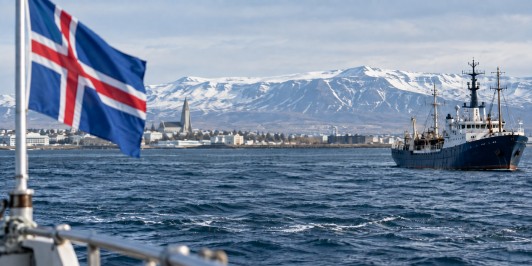
The Icelandic government is preparing to propose a new law that would establish a permanent prohibition on commercial whaling, a significant step that would leave Japan and Norway as the only nations still engaging in the practice. The legislative proposal is set to be presented to parliament in February, marking a pivotal moment in Iceland’s ongoing debate over whaling. This initiative comes in response to longstanding criticism and campaigns from animal welfare and conservation organizations that have been advocating against whaling due to ethical and environmental concerns.
Iceland’s whaling activities have primarily focused on fin whales, a species classified as vulnerable. These hunts, conducted under a government-sanctioned quota, occur annually from June to September, with numerous fin whales caught each season. The new legislative measure has garnered the backing of various animal welfare groups, who argue that commercial whaling poses significant threats to whale populations and the broader marine ecosystem.
Commercial whaling in Iceland resumed in 2006, despite a global moratorium that was introduced in 1986 to help protect whale species from over-exploitation. Similarly, Norway restarted its commercial whaling operations in 1993, while Japan exited the International Whaling Commission in 2019, subsequently resuming commercial whaling within its territorial waters and exclusive economic zones. Should Iceland’s proposed ban be enacted, it would further isolate Norway and Japan as the remaining practitioners of commercial whaling.
The international whaling moratorium does allow for exceptions, particularly for indigenous communities in regions such as parts of Greenland and Alaska. These communities are permitted to hunt whales, but only for nutritional, cultural, and traditional purposes, distinct from commercial endeavors. Iceland’s potential legislative change signifies a commitment to conservation and could influence ongoing discussions about the future of whaling on a global scale.