
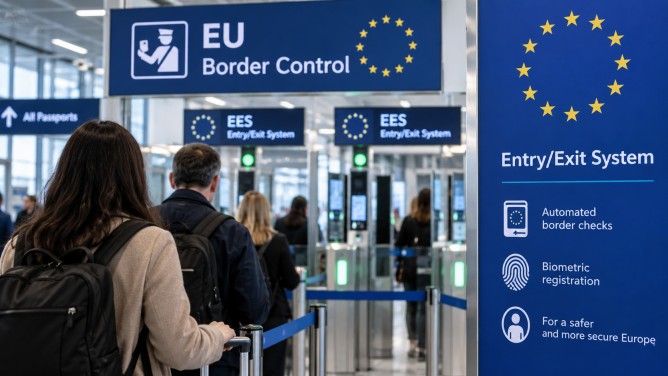
Travelers heading to the Schengen area from outside the European Union should brace for potential delays as several European countries are postponing the full rollout of the EU’s new Entry/Exit System (EES). This decision impacts non-EU travelers who will eventually be required to undergo biometric checks, including fingerprinting and facial imaging, at airports and other border crossings.
The EES, officially launched last October, is experiencing implementation setbacks due to technical and operational challenges at busy travel hubs. France, Greece, Italy, and Portugal are among the nine countries requesting additional time to prepare for the system’s full deployment. Despite these delays, the system has already registered around 200 million entries and has prevented approximately 70,000 unauthorized entries into the Schengen area, according to EU sources.
While countries like Spain have moved ahead with the system after overcoming initial hurdles, others, including Germany, Malta, the Netherlands, Switzerland, and Belgium, are still in the process of adapting their infrastructure to accommodate the new requirements. Major airports like Frankfurt and Schiphol have begun implementing biometric checks, but smaller airports continue to face significant challenges in terms of capacity and infrastructure.
The International Air Transport Association has expressed concerns that the new system could lead to longer wait times, especially during peak travel seasons. In response, a pre-travel application named “Travel to Europe” is being introduced to streamline the process. This app allows travelers to submit their passport details and facial images before arriving at the border. Currently operational in Sweden and Portugal, the application is expected to expand to additional countries soon.
As the situation evolves, travelers are advised to stay informed about the latest developments regarding the EES and to prepare for possible delays at border crossings. The gradual implementation across various countries highlights the complexities of introducing such a comprehensive system across multiple jurisdictions.